Acrylic sheets are widely used in sanitary ware, bathtubs, and industrial fields. Extrusion is one of the most important methods for producing acrylic sheets. Understanding the working principle of an acrylic sheet extrusion machine helps customers better assess sheet quality, performance stability, and overall production level.
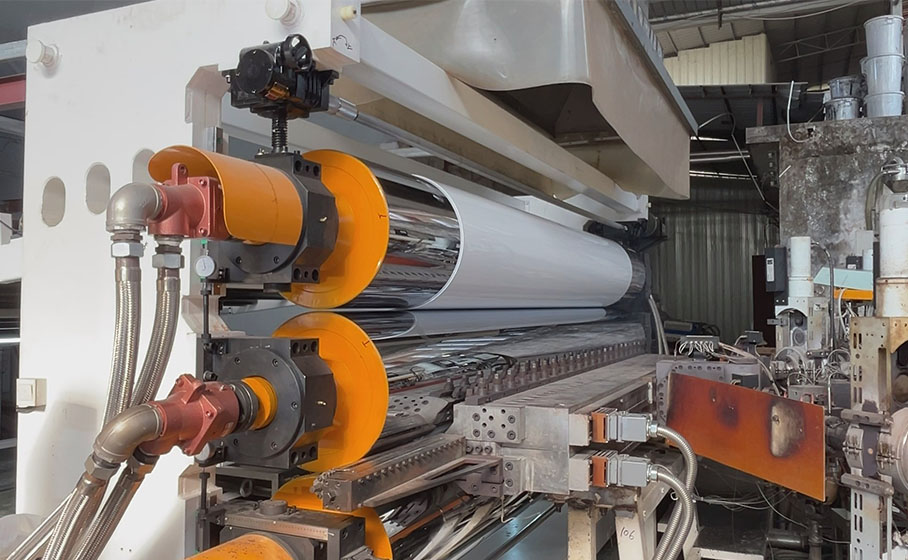
This article will systematically introduce the working process of an acrylic sheet extrusion machine and the role of each stage in sheet quality control.
I. Raw Material Feeding
The first step in extrusion production is raw material feeding.
Acrylic sheets typically use PMMA (polymethyl methacrylate) granules as the main raw material.
The raw material enters the extruder through a hopper and is continuously conveyed into the barrel by the rotation of the screw. A stable and uniform feeding process is crucial, as any fluctuations can lead to uneven sheet thickness or surface defects.
II. Heating and Melting Process
Inside the barrel, the raw material passes through multiple independent heating zones. Each zone is precisely temperature-controlled, allowing the acrylic granules to gradually heat up and melt uniformly.
Temperature control greatly affects sheet quality:
Too high a temperature may lead to material decomposition, blistering, or yellowing.
Insufficient temperature will result in incomplete melting and a rough surface.
A reasonable heating process ensures that the acrylic material reaches a stable and uniform molten state.
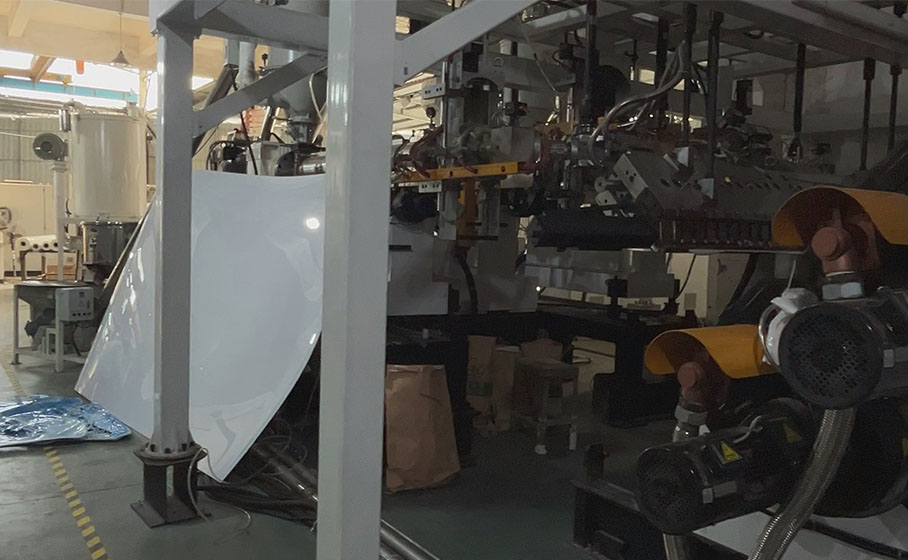
III. Plasticization and Homogenization
During the continuous rotation of the screw, the screw mainly performs three functions:
Pushing the material forward
Compressing and plasticizing the material
Thoroughly mixing the melt
This plasticization and homogenization stage eliminates unmelted particles, making the molten acrylic more uniform, thereby improving the transparency, strength, and surface quality of the sheet.
This stage is particularly crucial for acrylic sheets used in bathtubs, directly affecting the subsequent thermoforming effect and appearance.
IV. Die Extrusion Forming
Once the acrylic is fully plasticized, the molten material is pushed to a flat die (T-die).
The die mainly determines:
The width of the sheet
The initial thickness distribution
The edge quality
A high-precision die design ensures uniform melt flow across the entire width, thus achieving stable thickness control.
V. Cooling and Shaping
The acrylic sheets just extruded from the die head are at a high temperature and need to immediately enter the cooling and shaping system.
This system typically includes polishing rollers and a cooling table, whose main functions include:
Controlling the final thickness
Improving the surface flatness of the sheet
Eliminating internal stress
Preventing warping and deformation
A uniform and slow cooling process is a key step in ensuring the dimensional stability of the sheet.
VI. Cutting and Finishing
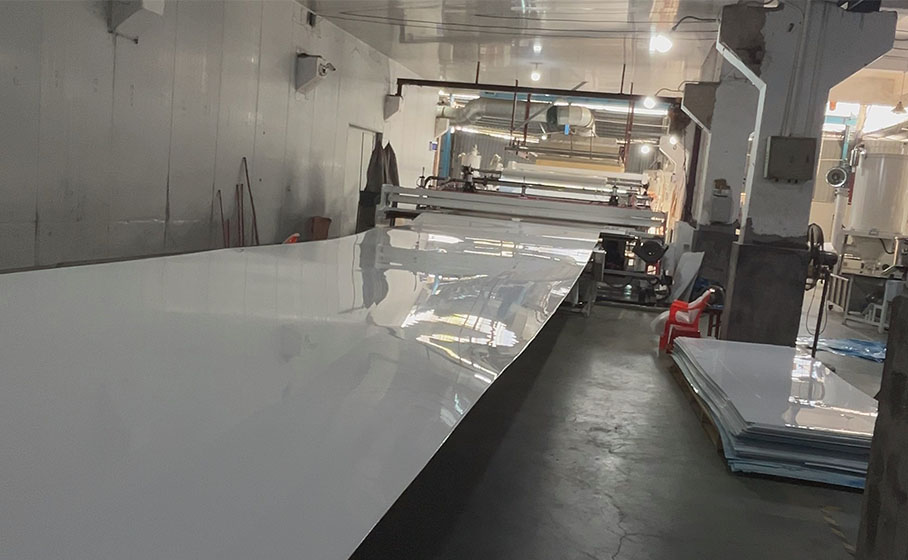
After cooling, the continuous sheet is cut into standard or custom sizes according to production requirements.
After cutting, quality inspection is required, including:
Thickness tolerance
Surface appearance
Transparency
Flatness
Qualified acrylic sheets are packaged and stored for subsequent processing, such as vacuum forming, thermoforming, or bathtub manufacturing.
VII. The Importance of the Extrusion Process for Acrylic Sheets
The extrusion process has the following advantages:
High production efficiency
Stable thickness control
Consistent mechanical properties
High surface finish
For applications such as bathtub manufacturing, the quality of the extrusion directly affects the forming performance, appearance quality, and long-term service life of the sheet.
A high-quality extrusion process ensures that the sheet is heated evenly and formed smoothly during heating, and maintains a good appearance in the finished product stage.
VIII. Summary
The working principle of an acrylic sheet extruder is a continuous production process that integrates feeding, heating, plasticizing, forming, cooling, and cutting.
Each step plays a crucial role in the final quality of the sheet. Only through advanced extrusion equipment and strict process control can high-quality acrylic sheets be consistently produced to meet the needs of sanitary ware, bathtubs, and industrial applications.
A deeper understanding of this production principle helps customers make more professional and rational judgments when choosing an acrylic sheet supplier.


Global High-quality Acrylic
Bathroom Materials Supplier
Phone+86 139-2427-7813
E-mailhugopmma@outlook.com

 English
 Russian
 Spanish
 Portuguese
 Arabic
 German